Saturday, January 25, 2014

The Cheese Stands Alone (In Which Tempest Explains ALL THE THINGS...or at least what makes for a unique dancer...)

Part of my personality involves the drive to know what's going on everywhere in the communities I am involved with- locally, nationally, internationally. (The other part of my personality questions whether this is a good thing, and perhaps it would be better to live in an information black out cave...)

So I notice the who/where/what in the teaching and performing sides of things, and try to familiarize myself with new names/faces involved in events.  And sometimes I get to go "Oh wow! cool! different!".

Sometimes. In fact, that happens a lot less than I would prefer.  More often it's a..."Err..who is this again? They're offering what? Why?" and I start to suspect that I'm in some version of the original "Return to Oz"*  - and it's really just pop a different head on the same body...or just switch out the tattoos.

*(Admission: I saw that movie only once. In grade school (a Catholic school).  And the only part that has stuck with me three decades later is the hall of heads...)


I'm looking at the same sort of movements (mainly combinations), same expressions, same music/musicality, same sort of costuming.  My eyes glaze over and my heart sinks.  It gets worse when I check in on names I haven't seen in a while, and they have seemingly joined in, losing what I saw/considered what made them, 
them. 

Then I see a line-up of all of the same, and I wonder how students pick out what to take for workshops?  Same topics, slightly different face? Is that what sells? Why all the same, again and again?

It depresses the hell out of me.  How did we get from unique and diverse views to some sort of globular cloned mass? Is it about fitting in?

Now, it's not really that bad.  I know this. Really I do, but that's the feeling that comes over me from time to time, and I wonder.  Am I missing something? Should I change?

Then the part of me that also made the argument for the cave earlier, slaps me around.  (Seriously, Geminis have cornered the market on a unique form of masochism...) And I count my blessings for the awesome and amazing folks who take my classes and my workshops, because they are solid proof that there are dancers out there who want to sincerely develop their own style. That they want something different, and it truly does matter to them. This reminder makes my heart lift and my spirit soar. And I watch the dancers who I have mentored over the years truly come into their own...and it's so damn beautiful!

It's easy to be a clone. It's easy to look like everyone else. It feels safe. It can feel so right.  But it leaves you mute and backs you into corner, which is artistic death, IMHO. (And for some reason, this here makes me think of the goddess Media from Neil Gaiman's "American Gods"...).  Of course, not everyone wants to really be an artist.  (This is hard for an artist to understand, I must confess...)

Years ago, I was having a discussion with a student about a rising dancer in the year - I didn't quite get why this dancer was popular - they weren't doing anything that was different or unique - instead they were very much a clone of Big Name popular dancer.  My student said, "Yeah, but they're OUR local version of Big Name."  This was somewhat of a revelation for me.  Like the appeal knock-off of a Brand Name Designer purse - you know it's not really Brand Name, but it looks close enough and was cheaper, so why not?  (Which could be a whole other blog post...but let's not go there now...) And so the clone dancer gets exalted for being the local knock-off, gets pushed to the next level, without ever really developing what could make them THEM - finding their inspiration from within, or really being valued for what they could bring to the table utilizing their own ideas/skills.  Without that, they're pretty much guided in the direction to teach how to be a clone, versus how to be your own dancer.

It really is the hardest part - finding your own voice, your own inspiration, your own way of doing things.  It takes a lot of hard work to push through the crowd and define yourself and to do it well.  It also requires a great deal of bravery.

Which also explains the large amount of envelope pushing that has been more prevalent over the last decade. (Actually, a lot of it has gone beyond envelope pushing - it's more like throttling - and someone's knocked over the mailbox and taken out the delivery person in the process.)  

Think about it. You get known for being a great clone. Well, now there's also 50 other great clones - what can you do to stand out?  Lightbulb!  DO SOMETHING DIFFERENT! And that tends to involve coming up with something weird/unusual/wacky/bizarre combination of elements because you have to STAND OUT!

But here's the thing.  You may stand out for doing something weird/unusual - but that doesn't make you different or unique.  Or mean that it's a successful, sustainable idea. In order to stand out, you need to be you.  It's not about pulling a stunt or a schtick or a gimmick.  That's a thing.  That's not you. And it's not going to grow with you over time.  Being you takes time.  It's a journey, but in the end, you'll see the difference.  Once that happens, it won't matter what you're wearing, or what music you're dancing to, or what style your make-up is - people will know you for truly being you.

And the best part is? You don't have to have any hard and fast ideas about what it means to be you.  You just have to trust yourself and sincerely explore the possibilities in front of you.  No, that's not easy, but it's so worth it.

Go forth, be brave. Be you!


Monday, January 13, 2014

A Note About the "Contributions" Series...

Photo by Barry Brown, 2002, from the same
 series that grace the splash page of the GBDR site.
I was going to make this note on facebook, but I figured it's best to place it here:

I am very sure that for every aspect that I have mentioned and will mention in the article series concerning my contributions to the styles and fashion of/in bellydance, there will be someone chirping up saying "but I did that first back in some obscure time/location."

That may be entirely true--or not, as memory tends to alter truth to favor perception over years.  Either way, it has been well established that the Muses are a slutty bunch. It is totally possible for a good idea to crop in several brains/locations/communities all about the same time. I believe a lot of art and fusions tend to start this way, among other things, as people with similar experiences seek for solutions to the same problems.

(This is why I have never claimed that I alone "invented" Gothic Bellydance - but I certainly had the largest continuous role in kicking off the movement and influencing directly and/ or indirectly and paving the way for every major instructor who went forth to perform and teach it from 2003 onward - and there's clear, multi-level documented proof of it all....ANYWAY...)

My point is, through this series of articles, I am not saying that someone else didn't or couldn't have come up with any idea first. But, as my years of working in the fashion industry have proven, something is not a trend until it you can trace a visible origin, and see it repeated, replicated, knocked-off, copied, and re-invented. It's not about where it started or who started it first (unless you own the copyright), but where did it take off - on a national or global scale? 

Every contribution I have discussed or will discuss focuses on what outside-of-the-bellydance community influences I personally had that lead to the development of that contribution. That is one the biggest points for me - that I didn't look to other bellydancers to find my inspiration - most often I found it from outside of the community and/or from historical resources. After I brought it in, and it was photographed/videotaped/talked about, it then bounced within the community, with pretty much a life of its own.  Some people may have even done it better after that.  


So sure, someone may have "done it first" in their corner of the world years before anything I mention, unknown to me or the larger bellydance world, but did it start a documented global trend? No?  Then there's 4 letters for that.

Thank you. 


The Rise of Hair Falls


This is the first part in a series of articles on my contributions to bellydance style/fashion. Because you wanted to know.  So it's totally your fault. 

It all started with Jessie.

Jessie was a fellow RISD student, majoring in Painting while I majored in Printmaking.  I'm a bit foggy on how we met, but my junior year I had a second studio in the What Cheer Painting studios, so maybe there...or maybe at Club Hell (the local goth club) or maybe through the Cauldron of Annwyn Pagan Society that I led, or maybe whatever that force is that brings like minds together...so somewhere around 1998. She introduced me to the concept of fake hair in unnatural colors, which she was experimenting with.

This development was incredibly exciting for me, as I had discovered that to dye my hair any sort of interesting color took a LOT of bleaching, which my scalp and fine hair did NOT like.  So here finally was a chance to have cool colored hair without the pain and frustration!

Through Jessie (she was known as "Mobile Jessie"), I discovered the work of Lana Guerra, who did amazing things with dye, Ashbet of PsySheep - who made amazing falls and wigs out of incredible yarn, and many other talented hair ladies.  There was a particular online "Fake Hair" board that was central for all discussion in things fake hair in the Goth community - where to get it, how to make it, who to buy from, how to take care of, etc.

I also got into bellydancing shortly after that, and even with my first performance, I had my eyes set on making sure my hair was part of the costume too!  My first attempts involved braids and coins - modeled after the lithographs of Ghawazee dancers (see image above), which used my own hair and added fake hair.

Natural was good for that look, but I wanted the crazy colors! I was on quite the budget, so I had to DIY instead of buying custom. I tried to find the right yarn to make my own hair falls.  Alas, the type of yarn Ashbet and others used "Colinette Point 5" was imported and VERY expensive (to me, about $30-$50 a skein).  This was the yarn that actually looked like REAL dreaded hair, just in really awesome colors (something to make note of!) - and at the time, the only kind like it on the market.

After relocating to California, I came across Sarah of ikickshins.net when she was fairly new and starting out (she now has an empire of awesome!).  I had a desire of peacock-colored hairfalls to go with the peacock costume I was making, and her falls were in my price-range, so in 2002 I placed my order!

So here comes shocking truth #1 - the first crazy-colored, dreaded hairfalls were teamed up with a beaded "cabaret" costume - and debuted at Rakkasah 2003, not at a Tribal event! (photo below at a Moroccan restaurant, some point later that year)


It wasn't until I commissioned Sarah for another set of falls - in black/white, with twists - to go with a costume that was more vintage-inspired, that it started to get a little more "Tribal" in look - first to go with a beautiful assuit panel skirt that I had been gifted for Tribal Fest 3, and then a more silent-film inspired costume that I performed in for Festival Fantasia that October. (Festival Fantasia was the Oriental "older sister" counterpart festival to Tribal Fest).  These falls also became the iconic ones that grace the splash page of The Gothic Bellydance Resource. 
"silent film costume"
"assuit panel skirt, ghawazee & sleeves"
I also commissioned Sarah for a "natural" colored set of falls, and then a really luscious extra full "dolly" black set, that debuted with the first ever corset belt and bra (which also happened at Rakkasah - 2004!)
"natural" falls with an early pair of Mardi Love Cowrie tassels

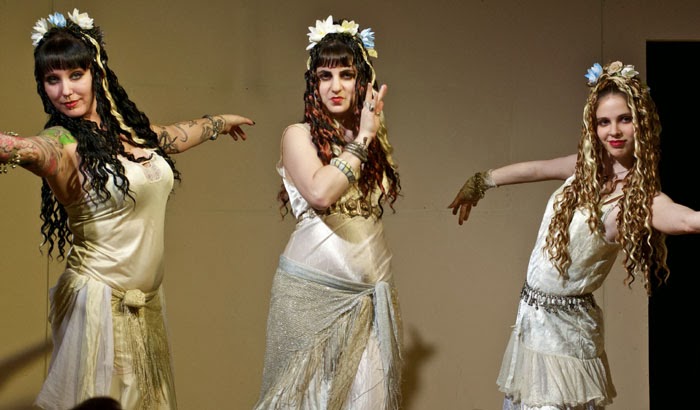
Surprisingly, the falls caused quite a stir.  While cabaret/oriental dancers have been using fake hair - a la wigs and extensions -  for as long as anyone can remember (and there were certainly theatrical productions that utilized all sorts of crazy hair and wigs) - and unnatural colored-hair was seen on punk folks from the early Tribal scene, folks who had dreads naturally (Melodia had gorgeous natural dreads when I met her back in the day) and the Goths had their falls for club nights and dressing up, no one was purposely using crazy-colored, dreaded falls to go explicitly WITH their bellydance costuming. It just made sense to me that my hair should match my costuming! Print and online mags took notice and spread the word.  And I was more than happy to spread the word of my hair lady to anyone who asked!  In fact, the next couple of years, Sarah made bunches of falls for me to sell at events (I believe 2004-2006 at Tribal Fest).
Rakkasah 2004 with Solace, corset bra/belt,
dolly falls, and blue strands, hair tassels
Another view of the "dolly" falls, that also had
black "rex lace" woven in and shiny beads

In 2005, I cut my hair short to a bob to more easily to pursue more vintage/20's style pieces...and to give my scalp a break. My skin never agreed with California, and so on top of heavy falls, which required tight ponytails and buns, and LOTS of hair sticks to stay put, my scalp/hair had taken a beating I had some dreads installed in my hair for about a month - mixing my natural color with blonde (I call this my "Fraggle" stage (see left image, from the first year I taught at Tribal Fest).  The red hair I'm wearing on the cover of the Gothic Bellydance DVD were on large clips.

And after the release of the DVD and touring around the US in 2006, and happily sharing my resources with everyone - the world of hairfalls had exploded in the fusion scene.  It was really was true - everyone and their grandmother had some variety of falls!  Alas, when it came to yarn falls, a lot of folks missed the point of those initial gorgeous PsySheep falls - so a lot of cheap crazy yarn falls hit the stage - and also not a lot of folks got the concept that your falls should look like they are an integrated part of your headdress - not just plopped on top of your head or ponytail.

By late 2006-early 2007, I started focusing more on headdresses and other sorts of headgear to adorn that piece of real estate - the HR Giger headdress that was featured on "Revelations", mini-top hats (another influence I brought in from the Goth scene, and made until folks flooded the market), fascinators, the "Salomatra" Mucha-inspired headdress with braided falls, the Metropolis headdress, and so forth.  (As you may have guessed, I believe it's a very important thing to adorn your head when performing!).

I think it was Tribal Fest 2009 or 2010 when I fell in love with curly braids at the Diva Dreads booth. I had been friends with Brandie and her family for several years, and noted to them that there was definitely a market for excellent hair falls - and someone to show folks how to properly install them! With their mad skills and years of experience of working with braids, dreads, and other fake hair for other markets, they've taken the bellydance world by storm! I ended up custom-ordering a set for me, and more for two of my students - together we performed a siren-inspired piece!  I especially liked that Brandie's falls were on elastics big enough to use as a headband, which was so much gentler on my scalp!
Morgen, Tempest, & Samara with their Diva Dreads curly falls
I also commissioned Brandie to make me two other sets of falls - really big earthy beaded dreads, and twisty ones, that I occasionally use for both performance and just for fun!  Especially when I am going for a more earthy or folkloric look. Some of those dreads ended up getting incorporated into the wig I made for the Klimt piece (I removed the beads and added wire).

Alas, blogger doesn't want to put any more photos or videos where I want them to appear, so we're at an end - but there you have it!


Thursday, January 2, 2014

Tending the Flame Without Burning Out

How would you rate your relationship with bellydance, right this moment? How does it make you feel in a word? Invigorated, inspired?  Or perhaps worn-out, exasperated?

Last month on the Winter Solstice, I gave my "Journey to the Underworld"* workshop - probably for about the 10th or so time I've done it since I first introduced it in Spring of 2009.  I designed it to be a workshop that would address and aid the inner workings of a dancer, instead of the outside.  I had been through several rough years myself, where I asked myself why did I keep dancing? Was it worth it? What was sucking the life out of it?

From long discussions with other dancer friends and the answers from the interview section of the workshop from students, it is clearly apparent that we all come to this dance with one person in mind - ourselves.  The reasons why vary: for exercise, to learn something new, to try something different, to learn about the culture, for love of the music, to build confidence, to join in with friends, to answer the call of your inner magpie (oh shiny!), to lose weight, etc. But at the root of all of these reasons is the same: we do it for ourselves: body, mind, spirit.

As we push further in our journey, excited about our new love for the dance, we encounter other people: teachers, fellow students, the general public, other dancers, musicians.  They influence how we do or don't do things, how we think about our own dancing, others', etc. And then there's life outside of dance: partners, family, jobs, homes, money.  And slowly, the dance becomes about more than just ourselves - for better and for worse.  The longer we're involved, the more we are weighed down with expectations, obligations, fears and negative experiences, community drama, exhausted resources, naysayers, copycats, and self-appointed critics.  Slowly, it all piles up, smothering our spark of love, like a snuffer to a candle flame, dimming it, threatening it, making us question if we should keep dancing.

Which calls in the guilt: guilt about letting down teachers, friends, students, about how much time you've involved, how much friends/family/partners sacrificed so that you could dance.  Along with the guilt comes the fears: "Why keep doing this? Am I really any good at it? Am I doing it right? Am I offending others, even though I am trying so hard to do it right? What was I supposed to be getting out of this again?  I don't feel like going to class, but if I don't go, I'm missing exercise, which makes me feel worse...I'm supposed to perform at this event, but what's the point? I'm tired of fighting/working so hard when so-and-so just goes and ____! I loved this once, but I'm not so sure now...does that make me a bad person?"

It's a difficult place to be in, and we often feel alone in what we're experiencing, but I'm here to tell you, you're not. You are not alone. In fact, there's a lot of dancers in the same boat.

Let me tell you about me: my passion for the dance rocketed my journey - I moved thousands of miles to study in California, where I quickly became involved in a larger growing movement.  My ideas, my work, my look propelled me along even faster, and I got caught up in other people's enthusiasm for what I was doing.  My heart was in the right place, but I didn't have enough experience to balance it out.  My ideas were ahead of my body - I was good and there was talent, but it would be  several years until everything evened up.  Yes, there was a lot of praise, but there was also a lot of criticism - some deserved all things considered, but poorly delivered, mainly out of meanness and jealousy.  People I thought were my friends used my "fame", ideas, and abilities to gain their own traction , then walked all over me.  I didn't understand, as I give freely to those I care about because I have always felt, if I am doing well, so should my friends.  I was hurt, angry, sad, and went from being someone with a lot of self-esteem to borderline insecurity and self-doubt.  I knew I was a good teacher and always felt rewarded by it, but I began to loathe performing.  I felt like everything I did was being scrutinized and compared, out of context or reason - and when that sort of fear grips you, it tends to become self-fulfilling.  Physically distancing myself helped: I ended up in a location where there were no other teachers within an hour of me - and the larger community felt more like "my people" when I got involved with them.  I focused on teaching classes, producing events, and the healing started.

But I didn't realize it until I was on stage at the Gothla Gala in March 2010.  I had been under a lot of stress from everywhere: my day job, producing the event, home-life.  My journey to the actual event involved a missed flight that left me stranded overnight in Detroit.  I was exhausted, worn-out, and fed-up, and about to close the biggest show yet in front of a sold-out audience, with a musician I had never performed with who wasn't playing the instrument I thought he was going to use.  Somewhere in that moment, I just stopped caring about everything and everyone else. I didn't care how the performance would go, what people would think, what would happen afterwards, what it all meant.  I just breathed and stepped out into whatever would be.   And it was in those few minutes on stage that everything changed.  It all slipped away - fears, expectations, obligations; I could feel that flame for the dance grow brighter - more than it had in years.  Everything had caught up: heart, body, brain, spirit, and I found myself in that moment.

I didn't fully realize the implications - I just knew it had felt different, but looking back now, I can vividly see that was the turning point.  All those times I thought about not dancing any more? It was because of everyone else and their effect on me.  How they made me feel. But the truth is - we can't dance for anyone else, if we can't dance for ourselves first.

So if you are feeling exhausted, if you're not sure if you should keep dancing, if you're wondering how to rekindle that flame - clear away the debris.  Clear away everyone else's obligations and expectations.  Reconnect with that part of you that first fell in love with the dance.  Listen to the music and let your body move without questioning it.  Just let it move.  Let your spirit flow and open up and just enjoy how it feels.  Don't think, don't choreograph, don't question, don't critique.  Just be a body discovering the music and open up.

Go ahead, dance for you.  You don't need my permission or anyone else's to do it - just your own. You will feel the difference.

Live. Love. Dance.

*Description of "Journey to the Underworld" workshop: "When was the last time you broke down your own facades and explored the truth of what lays bare underneath? Are you brave enough to look and become stronger as a dancer for it? Being a part of the bellydance community for any length of time affects us in so many ways, many below the surface that can influence how we look and feel about ourselves and others. In this dynamic and unusual workshop, we will explore through exercises and movement combinations the mythic concept of the Descent and Encounter in Mediterranean, Middle Eastern, and Indian cultures. This is a safe and supportive opportunity to challenge yourself mentally and physically, while discovering who you are or wish to be as a dancer. Warning: This is not a "woo-woo" or "new-agey" class, but it will ask you to push your boundaries."

Tuesday, December 31, 2013

The beautiful awful truth of the Internet

Hunt's "Lady of Shalott" weaving her web..
I got into reading Tarot for fun during college, found out I was very good at it, and it started to become a good way to make extra money since my "real job" as a fine art gallery director didn't cover the bills.

After a major move to the West Coast, instead of going for a job at a museum in SF, I got a job doing readings full time at a very large metaphysical store in Silicon Valley that had multiple psychics working at once (at least 3-4 per shift). Shortly after being hired, I was informed that I was to do "phone readings" in addition to in-person ones, which came as a surprise (who I am? Miss Cleo?), but there I was, being handed the phone and the client's name.

It was through my phone clients that I learned something very interesting about human perception.  Many of them eventually came in to the store to see me in person, and every single one was shocked to discover I was only in my early 20's.  They had assumed I was a very mature woman, in my 40-50's - because of my manner of speaking: tone of voice, vocabulary, and ability to listen.

Fast-forward to the other week, sitting in a room full of somewhat-strangers at a party, many of which who were anywhere from 10-25 years my senior. Now, despite my ability to boisterously teach dance to large numbers of people, perform "half-naked" in public, or to give spiritual advice to strangers, I am very much an introvert. I tend to listen and observe long before joining in. And watch the inadvertent "sizing up" that happens prior to my opening my mouth.

Genetics have been very kind to me in some ways, if the large number of people who have asked me what school I go to, or who carded me in the last year is any sort of indicator. Combined with the creative way I adorn myself, most people who just experience me visually assume I'm still in my early 20's. And so I tend to get labeled and dismissed as "young, skinny, pretty/weird, goth girl" - which means with some older crowds, an automatic discount that I could possibly offer anything insightful or full of experience to a conversation. Despite the reality that I'm well on my way to my 40's, have traveled the world, experienced more of it than most people twice my age, and am a pretty knowledgeable geek on a variety of subjects.

Being dismissed for how I look is certainly not the worst problem anyone can have for sure, but that, and being a professional artist by trade, it makes me think about visual implications.

And it brings to mind a lot of the heated interactions I have seen online in the last couple of years.  Especially the ones where the initial thought is a discussion about bringing about social justice, gender equality, minority awareness, positive body/health issues, etc.  It goes like this: someone brings in an intelligently worded counter-response to whatever is posted, and the result is something along the lines: "You are ____! You have no right to say anything in this discussion!" (Especially if that someone is  a "white", "straight" cis-male. Why does that make it OK? How does denying this person their right to add respectful input solve the injustice? Who are we to say that someone else can/can't speak?)


My response is, what year is this? At what point does wanting equality for all, actually MEAN equality for ALL?

History throughout this entire planet has shown that systematically, every group that has been the oppressor has also been the oppressed at some time.  History is also that - history. A person of a particular ethnic group is not responsible for their ancestor who may have caused my ancestors tragedy and grief 100 or 1000 years ago. Likewise, the way a person looks doesn't mean they fit any sort of stereotype. What someone looks like speaks nothing of where they have come from, what they have experienced, or who they are.

So if we want equality for all - and I really mean for ALL, regardless of age, gender, race, sexual orientation, we need to embrace what Internet presents us with: it is the great equalizer, it brings everyone to the table, for better or for worse.  And that if you want people to understand where you are coming from, and what YOU have to say, then you also need to expand your brain to understand where others are coming from, before dismissing what they have to say.  Because in order to truly bring equality, we need to focus on bringing balance and understanding. That's the beauty of the Internet - it can educate and help us share in ways never before available to humanity on such a large scale.

Now the awful part of it? In order to truly want equality for all, then we all have to shed labels.  Yes, whatever words you perceive to define you, whatever makes you think that you're an authority who can tell other people that they're "doing it wrong", whatever you think makes you a special snowflake - you have to let go of it. (Yes, I understand this paragraph pretty much eats the meta, but roll with me here.) The other thing the Internet brings us is the ability to make us seem to be someone or something we're not - do we ever really know who's on the other side of the screen? Are they who their avatar or profile says they are? So if you're going to dismiss (or agree with) someone based on their apparent labels, then you are allowing others to do the same to you.  Effectively defeating what you're fighting so hard for in the first place.  There is a better way to do it.  Unless you're afraid to abandon your own labels.

Don't assume - allow instead.
Don't react - receive instead.
Don't divide or defend - discourse instead.

Awareness comes through openness and positive effort, which opens the door for future change.

2014 is at our door right as I write this - why don't we ALL make the future now?

Let us all work to bring equality for real - not just a group, race, minority, majority, faith, gender - but for all of humanity. That's the only way it's going happen. 


Monday, November 25, 2013

Grounding and check-in!

Whew! It's been 5 weeks since my blog post, with good reason! But wow how time flies!

First, we were on tour from October 17th onward to November 4th.  We did stops in Atlanta, GA, Greenville, SC, Asheville, NC, and New Orleans - then journeyed to California to film the DecoDance DVD - and take care of wedding stuff!

Yeap, cause pretty much as soon as we got back to Seattle, we had just a week to get ready for the wedding.  Which for me, included finish making the dress, headdress and related accessories, the bouquets, the cake-topper, the guestbook, the favors, etc.  And yeap, got it ALL done.  Then we flew back down to the Bay Area and drove to the Monterey Peninsula (as well as our closest family/friends did as well), had a beautiful amazing event, and then the next day flew to Arizona for our honeymoon.  And we got back yesterday - and of course the cats were VERY happy to see us.

So..whew! Have a LOT to catch up on: a very busy schedule forming for 2014, lots of projects for many different things, and things to wrap up for 2013 (like the DVD!).  I have many new blog posts brewing in my head - and I will also make a post about the wedding dress, as a lot of you have asked how/what/why.  So keep an eye out, cause there's a lot more coming soon!

Wednesday, October 16, 2013

Performance P(r)imp?

When you perform a lot, getting ready tends to break into a kind of science, depending on how much time is involved.

If pressed for time, I can do it all in half an hour: make-up, hair, and ready-to-go in costuming.  And be solid and ready.

Ideally, I like to take about 15-25 minutes for make-up/hair, and have a good 10-15 minutes to futz around with my costuming, and 10-15 minutes for a nom/brain collection time.

And when I really can, give me two hours so I can linger in a bath (after teaching a day of workshops especially), take my time eating/snacking/de-braining, and the rest getting ready.

(and if I have to change costumes between sets, I can do it in under 7 minutes, though prefer 10-15 minutes to adjust if necessary, 20-25 minutes if major hair/make-up changes are involved)

So there you have it: as a professional, I can do it all in half an hour, but I'll gladly take about 2 hours if I have the accommodations and means to do so.  Most often when I am performing, I have taught for anywhere from 2-8 hours that same day, and if it's at a big event, probably took a workshop as well. And if I traveled far to get there, I'm probably doing it on less than 6 hours of sleep. Also, if I am traveling with the band, I'm going to dancing for at least 35-45 minutes, versus a regular bellydance show set that may be 6-7 minutes, or 12-15 total. For the record, I am NOT superhuman or abnormal - I have seen many old school pro's do the same in the same time or less, and they're 10-20 years older than me.

Hence my deep confusion and utter bogglement when folks tell me they can't take a workshop that ends 4 hours or more before showtime (or AT ALL that same day), because they need to prepare for their performance that night.

Sure, performing is important.  Doing the best job you can, especially.  But it's not the end-all, be-all of the dance experience, and not THE most important thing.  For me, it's about the learning and sharing that happens in the classroom  - what happens in class has much more longevity than any performance.  And time and time again, I have observed that those whose butts were in the workshops with me earlier that day, versus the ones who "needed the day" are consistently more successful on stage.  Same with teachers who told me they prefer to perform vs teaching - that they feel teaching is the only way they can get opportunities to perform - yet, their performances haven't grown, nor have their teaching technique over the years.

Also, I believe there's something to be said about actively pushing both your brain and your body the same day you're going to be performing.  On days when I only perform (not teaching or taking a class earlier that day), I always feel as soon as I get off stage that NOW I'm ready.  It's not enough to run through my set several times before I go on - I need to expand my brain and body past that piece to fully tap into what's possible.  It helps shut down the left side of the brain, and really engages the right brain. And whether I have taken or taught a class that same day, it's ALWAYS given me something else to consider for my performance that evening.  Much better than any amount of make-up.

True, there are extenuating circumstances for some folks, who have really valid reasons - family, work, illness, etc - but I think that most often, others have bought into this idea of the "sacredness" of performing - that they must save themselves all day for those precious 4-9 minutes on stage.  But if one actively works in the performance arts (music, dance, theater, etc) - this simply doesn't exist.  Rather it's full-immersion, full of practices, rehearsals, workshops, and other preparation - every day, that make for a successful performance.

I think it boils down to, if we want to be truly professional in our dance and outstanding in our performances, it's going to come from working both your body and brain beforehand. Then you can make it pretty.